
Ethical Recruitment as a Key Norm
Over the last decade, Thailand’s seafood sector has faced international scrutiny for indicators of forced labor and debt bondage, in particular affecting migrant workers from neighboring countries including Myanmar and Cambodia. Industry platforms such as the Seafood Task Force (STF) responded by adopting a Code of Conduct and auditable standards that prohibit recruitment and hiring‑related fees to workers beyond what the law permits, and by issuing guidance that itemizes worker‑chargeable and non‑chargeable costs, largely aligned with ILO fair recruitment guidelines.
At the same time, Thailand has progressively refined its legal and policy framework. The 2017/2018 Emergency Decree on Managing the Work of Foreigners (B.E. 2561) bars employers from charging recruitment service fees to workers (but allows workers to pay for “personal and work documents” including passport, work permit and visa)1, and in 2021 the Ministry of Labor clarified which expenses employers must bear, specifically Thailand-side expenses such as documents, transport, food/accommodation in bringing in migrant workers. These changes alongside global corporate due-diligence pressures have helped normalize the Employer Pays Principle (EPP) as the benchmark: no worker should pay for a job; all recruitment fees and related costs must be borne by the employer.
However, EPP implementation in Thailand face significant hurdles to mainstream. This article examines the current landscape and challenges of EPP implementation in Thailand, draws lessons from other sectors and contexts, and proposes that meaningful dialogue on collective responsibility is essential to accelerating broader EPP adoption.
Changes to Recruitment Systems
Thailand has signed bilateral Memorandum of Understanding (MOUs) with key migrant-sending countries including neighboring Myanmar and Cambodia. However, in the past 5 years MOU cross-border recruitment has declined with in-country recruitment now estimated to comprise 80% of regular labour migration.2
While a series of Cabinet Resolutions partly address the need for regularization processes for workers, under-regulated recruitment intermediaries remain widespread. The current policy landscape remains largely silent on who pays for registration and intermediary fees.
DIWA’s dedicated study on in‑country recruitment3 documents three parallel channels now operating: (1) formal (via Cabinet Resolutions, (2) informal (unregulated brokers/personal networks), and (3) hybrid arrangements that combine formal documentation steps with broker facilitation.
While in-country recruitment has been a longstanding practice, during the pandemic, many employers pivoted from cross‑border MOU recruitment to in‑country recruitment to manage labor shortages. While official costs for regularization are estimated to be THB 10,700 (US 300), the in-country recruitment study indicates that fees likely proliferated: workers reported paying for job referrals, document processing, service fees and so-called “police cards,” with typical in‑country cost bundles estimated to range from THB 20,000 (USD 569) to over THB 100,000 (USD 2845)—often financed by worker debt or payroll deductions. The current legal minimum wage in 2024 was THB 8,190 (USD 233) for 26 days of work, indicating recruitment debt equivalent to at least 2 months wage, and much more in some circumstances.
Recruitment Costs
At present, recruitment systems have not reverted back to the MOU system.
In 2024, DIWA conducted a survey with members of the Thai Tuna Industry Association (TTIA)4 and the results indicate that tuna processors have shifted towards in‑country recruitment, perceived as less costly and more expedient.
The Thai Tuna Industry Association (TTIA) is an industry body formed in 2013 by major tuna processors and exporters in Thailand. TTIA has taken several notable steps to align with international labor and human rights standards, including commitments to promote Good Labour Practice (GLP) standards among members. In 2024, TTIA, with support from Freedom Fund and Humanity United, engaged Dignity in Work for All (DIWA) to undertake a survey of TTIA member practices to better understand the implementation of EPP. The survey included 16 member companies who are part of the GLP program.
According to one tuna processing company, the cost of recruiting one Myanmar worker in 2024 through the MOU process was USD 348, compared to USD 178 for regularizing a walk-in Myanmar worker. Another company stated that recruitment for new MOU recruits amounts to USD 495 per worker. All survey respondents indicated that MOU recruitment costs have increased, by as much as 40% since pre-pandemic levels. This validated information DIWA has gathered from other sources as well, including audits in Thailand and engagements with recruitment agencies.
What EPP entails for suppliers
While stakeholders such as the Thai Tuna Industry Association have made significant strides in implementing the Employer Pays Principle (EPP) there remain key challenges to successful and robust implementation.
DIWA’s experience across industries, including electronics and agriculture, indicates that EPP entails fundamental changes and capacity-building for Human Resources systems. This includes establishing clear written commitments, structures, and procedures to guide EPP implementation; defining all recruitment fees and costs to ensure consistent understanding; and setting robust due‑diligence, selection, and monitoring processes for recruitment partners. It also requires strong, enforceable contracts with those partners, alongside systems for continuous performance monitoring and improvement of EPP practices. Effective worker‑feedback and grievance mechanisms are essential to surface issues early, and organizations must maintain procedures to address and remediate any recruitment‑fee violations that are identified.
What DIWA has seen in Thailand: Progress and Gaps
Industry associations, such as STF and TTIA, have been leading the issue of responsible recruitment, largely related to buyer requirements; however, the recent TTIA survey suggests that EPP adoption is not yet standardized across critical EPP areas and more fundamental changes are needed to ensure sustainable implementation.
Progress in management system adoption
The survey with TTIA showed that there has been progress in establishing management systems relevant to EPP, with 100% reporting policy commitments to cover all recruitment fees and costs. Based on self-reporting, the majority have also developed a cost table for fees and have assigned management responsibility for implementing the responsible recruitment program.
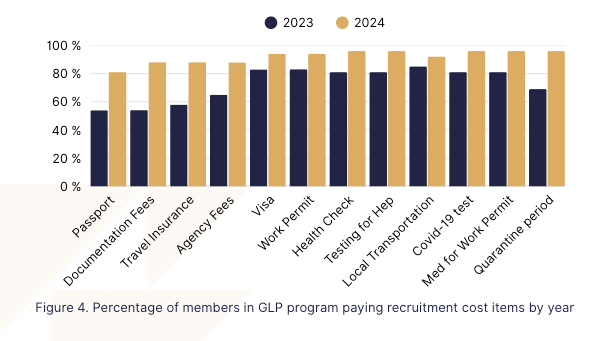
Buyer requirements are a primary driver for the adoption of EPP. The TTIA survey suggests that many members responded quickly to new requirements, as shown in the growth of employer responsibility for expense areas between 2023 and 2024. However, gaps remain, particularly in areas such as management review of responsible recruitment performance and worker verification processes.
DIWA’s experience suggests that worker verification and repayment procedures should be implemented in all scenarios as an effective check on debt bondage prevention and to enable workers access to remedy. However, the survey with TTIA indicates that most companies are not verifying fees paid and/or they are making selective repayments rather than implementing the policy based on worker-centered data. As such, the amounts repaid may not conform to the actual costs of recruitment. In other cases, repayment procedures are not applied to all cohorts of workers, leading to some workers being excluded from repayments.
DIWA’s work on EPP in other sectors also indicates that ensuring that all risks are assessed and addressed remains critical. For example, in our ethical recruitment programs in the palm oil sector, some companies may conduct worker verification after rolling out a zero fees program and still learn that a significant percentage of workers from certain pathways have paid fees, despite the policy. In those cases, a deeper investigation may be necessary to fully understand and address all risks.
In the electronics sector, where responsible recruitment has matured as an auditable standard, DIWA has seen the expectation for employer documentation also mature. For example, the Responsible Business Alliance (RBA) standard now assesses whether workers are required to pay fees as well as stipulates that if “fees are found to have been paid by workers, such fees shall be repaid to the workers. This clause provides a remedy for workers and focuses attention on employer processes to verify fees payment through proper documentation and other means, such as post-arrival worker interviews. This results in clearer expectations on suppliers to demonstrate that the policy is verifiable as procedures, logs, and contracts.
Across industry contexts and countries, greater emphasis and resources should be directed towards implementing EPP with robust worker verification processes, including independent assessments to ensure that implementation effectively addresses the true costs borne by workers as well as risks in recruitment systems. At the same time, DIWA understands that the challenges of EPP sustainability remain broader than verification alone.
Can EPP be Sustained in Thai Seafood?
The survey results from TTIA indicate that suppliers in Thailand are not yet confident that the EPP policy can be sustained. Several TTIA members reported that reimbursing workers for fees previously paid represents a significant financial burden for employers, particularly when combined with the upfront costs required for recruiting new workers. In addition, half of the members noted that they receive no support from buyers, with manufacturers supplying to markets in the Middle East and Japan specifically reporting an absence of incentive.
Fundamentally, the TTIA survey indicates that the increase in employer-paid recruitment costs, as much as 1000% from pre-EPP, has not resulted in pricing or contract changes. Buyer engagement in EPP implementation remains limited, confined to audits and training initiatives, with no evidence of support through contract price adjustments or preferential sourcing based on EPP performance. Furthermore, there are anecdotal accounts of buyers shifting their sourcing to countries where EPP compliance is not expected, underscoring the broader challenges suppliers face in sustaining responsible recruitment practices.
Cross-Sectoral Learning
DIWA’s experience in supporting EPP implementation across various contexts indicates that industry associations can play a leading role in mainstreaming responsible recruitment. In the electronics sector, for example, requiring robust employer data on hiring and recruitment practices, paved the way for evidence-based conversations between suppliers and buyers, resulting in actual changes to commercial agreements. This is not an open playbook, and each context and industry will need to land on what works. However, the maturity and sustainability of EPP, and its ability to reduce the risk of modern slavery, depends on our collective ability to have these hard conversations, and come together in real partnerships for change.
- https://migrationnetwork.un.org/practice/law-amendment-concerning-management-migrant-workers-thailand ↩︎
- https://thailand.iom.int/sites/g/files/tmzbdl1371/files/documents/2025-03/iom-labour-migration-profile-thailand.pdf ↩︎
- https://dignityinwork.org/in-country-recruitment-of-foreign-migrant-workers-and-risks-of-forced-labour-and-human-trafficking-in-thailand/ ↩︎
- The data for the study was based on self-reported recruitment costs and management system elements. While the data provides some valuable insights into cost shifts and progress in adopting better ways to manage human rights issues in migrant worker recruitment, the self-reported nature of the data and the absence of on-site verification, supporting documents, and worker interviews does not provide enough information for a robust and comparable analysis of recruitment costs across companies surveyed or the incidence of their adoption of responsible recruitment elements. ↩︎